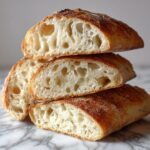
Description
Classic homemade sourdough bread with a crisp crust and chewy interior, naturally fermented with an active sourdough starter. This recipe takes time and patience but rewards you with a flavorful artisanal loaf baked in a Dutch oven for perfect steam and crust.
Ingredients
Scale
Dough
- 4 cups (500g) bread flour or all-purpose flour
- 1⅔ cups (375g) warm water
- 1 cup (200g) active sourdough starter
- 2 teaspoons (10g) salt
Instructions
- Mix flour and water: In a large mixing bowl, combine the flour and warm water until a shaggy dough forms. Let it rest for 30 minutes to allow the flour to fully hydrate.
- Add starter and salt: Add the active sourdough starter and salt to the dough mixture, stirring well until fully combined and uniform in texture.
- First rise with stretch and folds: Cover the bowl and let the dough rise at room temperature while performing stretch and folds every 30 minutes for 2 hours to develop gluten structure.
- Bulk fermentation: After the last stretch and fold, let the dough rise undisturbed at room temperature for 6 to 8 hours until it doubles in size, indicating good fermentation.
- Shape and retard: Shape the dough into a round loaf and place it seam-side up in a floured proofing basket. Refrigerate the dough for 8 to 12 hours to retard fermentation and develop flavor.
- Preheat Dutch oven: Preheat your oven with a Dutch oven inside to 450°F (232°C) to create an ideal baking environment with steam.
- Score and transfer: Score the top of the loaf with a sharp knife to allow controlled expansion. Transfer the dough on parchment paper into the hot Dutch oven carefully.
- Bake covered: Bake the bread covered for 20 minutes to trap steam, which helps create a crisp crust.
- Bake uncovered and cool: Remove the lid and bake for an additional 25 minutes until the crust is golden brown. Allow the bread to cool completely on a wire rack before slicing to set the crumb.
Notes
- Ensure your sourdough starter is active and bubbly before using to achieve good rise.
- The long fermentation times develop flavor, so do not rush the process.
- Use a sharp blade for scoring to get clean cuts for better oven spring.
- Cooling the bread completely before slicing prevents a gummy texture inside the crumb.
- You can substitute bread flour with all-purpose flour but expect a slightly less chewy texture.